Introduction: Changing careers, losing identity, exploring purpose
I was ready and eager to jump into my new career as independent after leaving the company I had worked for for more than 20 years. But the challenges were not (only) the practical ones on developing new mastery and building the business. I now realise that my colleagues had been my tribe, the workday gave me structure, and the company recognised and rewarded me. While I still maintained other roles in my life (husband, father, friend, etc) my professional one went through a crisis. What's my new professional identity? Not just an aspirational elevator pitch, but something I believed myself and could share sincerely.
Turns out I am not alone and not the first to think about these things. Psychology Today has a series of posts from 2019 on "Humanity's Crisis of Purpose"21. Countless books have been published, providing different perspectives and takes on it. As a student of personal growth most of my life and interested in the question of purpose, I have read many. But it was not until now, in this situation, that I had a real need for it. But the books, articles, podcasts and Youtube videos I consumed didn't provide a coherent, practical framework on exploring your purpose. What follows is my attempt to create that.
Before we dive in further, my story also shows something else: we don’t have to have a defined purpose. I was happy with my life over the past twenty years and thought often about purpose, but never prioritised exploring it further. The need only arrived as part of change I was going through.
Also, we should avoid falling into a performance trap, thinking we need a clear purpose statement coming out of this. It’s an exploration. If you can write one down for your life, or a role you have in life, that’s great. But I encourage you to enjoy the journey, regardless of where it takes you. (In full disclosure, at the time of writing this article, I do not have a clearly stated purpose. It’s more a nebulous direction in my head that I’m still exploring.)
I am very open to questions, feedback, and your interpretation, so here (and at the bottom) you'll find where you can best engage with this - either contacting me directly (jonas at jacobson.coach / Connect) or leave questions and comments on LinkedIn or Substack.
Background: Belonging, Purpose, Storytelling, Transcendence
Emily Esfahani Smith's "The Power of Meaning"1 does something rare in the purpose genre: it describes meaning without overselling it. The four pillars she identified through her research are a genuinely useful map: belonging, purpose, storytelling, and transcendence.
But where even this excellent book left me wanting was in the practical. Smith describes what it looks like when you have it, but even if you understand the framework perfectly well, she doesn't describe how to reach it.
A handful of frameworks try to answer "how", but they tend to split into two camps that talk past each other.
The essentialists (see Robert Greene2, Simon Sinek3) argue that your purpose already exists, encoded in your earliest obsessions and peak moments, waiting to be excavated. Greene points to childhood fascinations before socialisation overwrote them. Sinek asks you to mine your best moments for a pattern.
On the other side you have the constructivists (e.g. Steven Kotler4, Clayton Christensen5) who argue that you build it as you go. Follow your curiosity until it stacks into passion, then into something larger than yourself. Define your metric before life defines it for you.
Both approaches are legitimate but both assume something neither names explicitly: that you're already in a position to do the work. That assumption is where most challenges arise when working on exploring your purpose.
The Star Model
Rather than another linear framework, I find it more useful to think of this as a 5-pointed star: two foundational elements at the base, a narrow present-moment core in the middle, and two directions opening up at the top: one looking back into the past, one looking forward into the future, and then coming together on how you can explore going forward at the top.
The core of the star matters. Meaning doesn't become accessible by reading more frameworks, it becomes accessible by knowing you have the foundation in place and the mind space to be present.
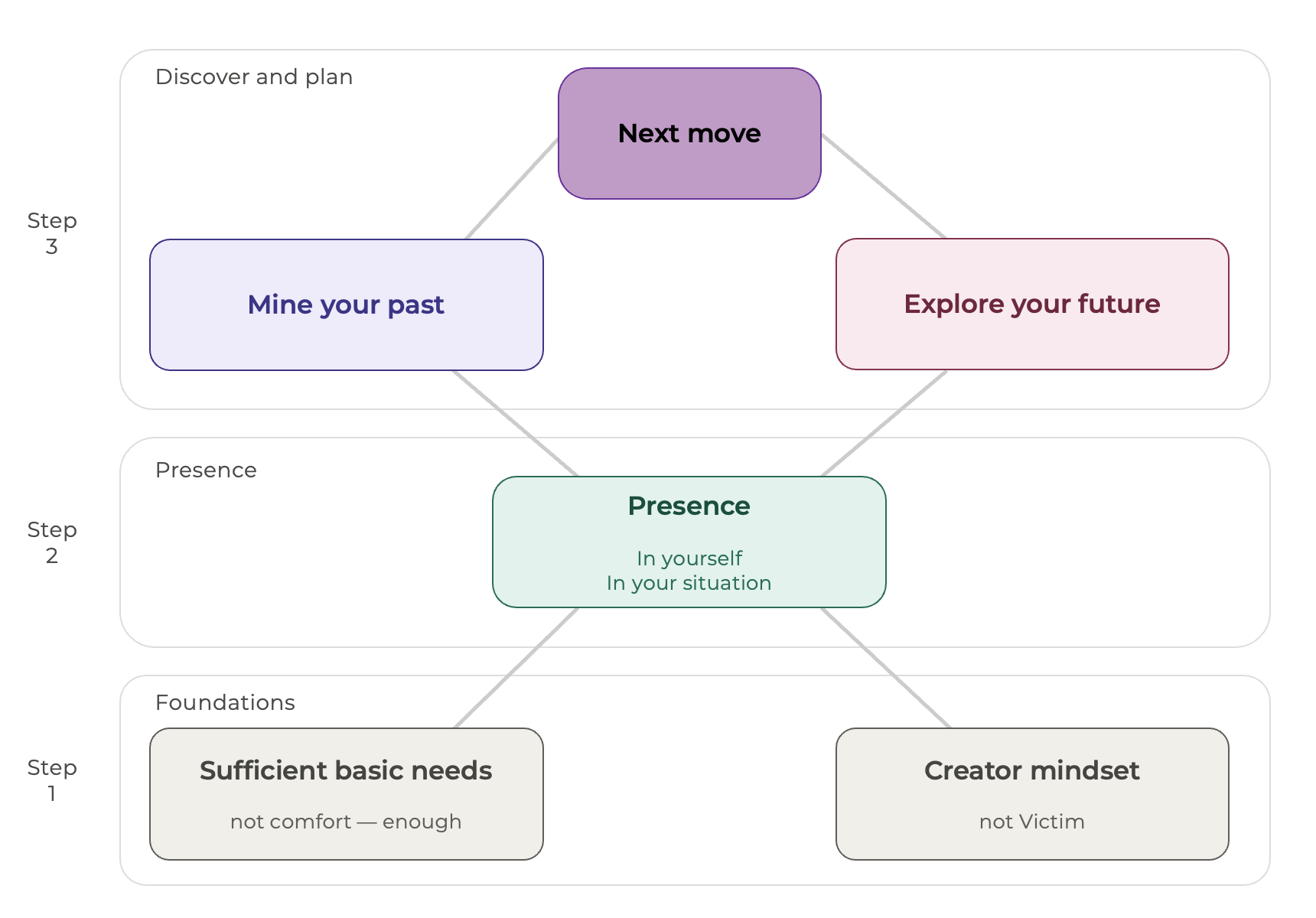
Step 1 — Foundation
Two preconditions need to be in place before anything else can take hold.
Sufficiency. Maslow's hierarchy6 is often misread as requiring comfort before you can pursue meaning. If you think about it, it doesn't. It requires enough: safety, basic health, somewhere to sleep. Not a guest room and intercontinental holidays. The conflation of sufficiency with comfort is one of the most common ways people defer meaning work indefinitely: "I'll focus on this once the finances are sorted / the house is right / the kids are through school." The base layers expand to fill whatever anxiety is available, often disguised as supporting dependents. Sufficiency is a decision, not a destination. For inspiration, Frankl7 was able to create meaning while being in a concentration camp.
To explore this, you can reflect and journal of what core needs need to be met for you to live a fulfilling (not comfortable) life.
Creator. The second precondition is subtler. Frankl7 observed in the camps that between stimulus and response there is always a space, and in that space lies our freedom. Covey built his first habit (out of seven8) on exactly this insight. Karpman’s Drama Triangle9 shows that we often fall into a role of Victim. (For more on this, see my other post.) In short, the Victim narrates from powerlessness. Emerald10 reframes the drama triangle into empowerment where the Victim becomes Creator. The Creator knows they are responsible for their choices rather than merely reacting to stimuli. They face uncertainty with curiosity, extend self-compassion without sliding into self-pity, and don’t ask "why did this happen?" but instead "what do I want to create from here?"
This matters because purpose frameworks applied to someone narrating from a Victim position tend to produce sophisticated victimhood, not clarity. "What is my purpose?" asked from that stance becomes "why haven’t I found purpose yet?" You need to be narrating as Creator before the work can begin and truly believe that you and your situation can change.
I suggest reviewing your situation and ask yourself if there are areas where you fall into victimhood. Is that holding you back? Can you still move forward?
Step 2 — Presence: in yourself, in your situation
This is the star's core, and it cannot be bypassed.
Listen to yourself
First, you’ll need to be genuinely in touch with yourself. As you go through this exercise, you need to be able to listen to what you're actually drawn toward, as distinct from what you think you should be drawn toward. Your body often knows before your mind catches up. In which scenarios does your body respond positively? What happens if you explore a tightness in your chest? What feels true for you? As Nietzche said "There is more wisdom in your body than in your deepest philosophy"20
Mindfulness practice can help here, especially body scanning, and learning to stay in touch with the body in the next exercises.
Accept your situation
Next, you’ll need to understand and accept your current situation. Given these circumstances, this transition, this loss, this opportunity, this challenge - what response is being called forth? Using Frankl7 as an example again, he could have framed his purpose as a psychiatrist helping people in a private practice. But he was in a concentration camp, so he worked on building his purpose in that situation, guided by his own question: not what he expected from life, but what life expected from him.
This is not a new insight. Marcus Aurelius, writing in Meditations11 nearly 1900 years before Frankl, arrived at the same position: the obstacle is not something to escape but to respond to. The Obstacle is the Way” as Ryan Holiday12 put it. Two millennia of the same question suggests it is fundamental to how humans create meaning.
Without this grounding, the work in Step 3 collapses. Looking back becomes rumination, looking forward becomes anxiety or fantasy. The present is precisely where meaning shifts from described to accessible and you need to sit with yourself as you move into the top of the star.
Reflecting and journalling can be helpful while reviewing your situation and your place in the world. What is life asking of you right now? What demands do you respond to or shy away from? What does that tell you? Remember to stay in touch with your body as you explore.
Step 3 — Discover and Plan
With the foundation in place and from a grounded present, we can now move into what books on Purpose often jump straight into. Two directions open up, both are valid and neither is superior. One tends to reveal itself to you rather than being chosen analytically. (For my part, having practised both, I have found that I have a future bias and have a hard time pulling out distinct childhood memories.)
Looking back — excavation and negation
Greene2 and Sinek3 both start here: what was present before the world told you what to value? What threads appear consistently across your peak moments? William Breitbart's clinical research13 on meaning adds two powerful tools: narrative (when did you most feel alive?), and legacy (what are you building and leaving?), both accessible at any life stage, not just in extreme situations.
Pull out a pen and paper and try to answer questions like: Was there some event at school where you were completely absorbed? When did you feel genuinely proud of who you were (not necessarily an achievement)? What stories from your life do you tell most often? What elicited strong emotions (also negative ones)? What do you keep coming back to without really intending to? What did others say they admired about you?
You’re looking for patterns from peak moments and / or obsessive interests. At some point in this exploration, I suggest inviting a partner to help as we are often blind to our own nature. I have used both coaches to guide my questions and my wife who could (maybe too easily..) point out patterns I was oblivious to.
Martha Beck14 and Parker Palmer15 add that it’s worthwhile exploring the opposite: the path through what pains you rather than what inspires you. Beck argues that the suffering you resist contains encoded information about what matters most, its inverse points toward your core meaning. Palmer frames burnout not as an energy problem but as the soul's protest against living someone else's life. What systematically drains you is as diagnostic as what energises you. For some, purpose can also be found in helping others avoid the pain you went through.
Here you can ask questions like: What do you hate seeing in the world? Maybe your calling is working to stop that from happening. Or what do you dread to the point of avoidance, even when avoidance costs you something - and what would the opposite of that look like? What have you been meaning to change for years but keep deferring, and what does that tell you? What recurring illness, injury, or exhaustion might be your body refusing to continue on the current path? Is there tension in your body when you think about specific events? All these negatives can be a source of inspiration for what you really care about and what holds meaning for you. For my part I have a hard time seeing someone excluded. If there’s someone sitting in a corner alone at a party, that’s the person I seek out to check in on (respectfully). This points to my value of inclusion and something I explore bringing into my purpose (next question is where and for whom).
Looking forward — construction and contribution
I find that Kotler's4 sequence is the most practical constructivist framework: follow curiosity until it deepens into passion, stack passions until they converge into a purpose larger than yourself, then align that purpose with a craft you can master. Christensen5 asks the harder question: what metric are you actually optimising for? Without a conscious answer, you default to what's measurable (money, status, busyness).
Manson's contribution16 is the one most purpose literature sidesteps: stop looking inward altogether. Commit to something beyond yourself and meaning tends to emerge as a byproduct, retrospectively visible rather than prospectively planned. This connects to Maslow's often-omitted tier above self-actualisation: transcendence; and to Frankl's fundamental reorientation: stop asking what you want from life and ask what life wants from you.
You can do a visualisation exercise, pretending it’s a number of years (2, 5, 10, 20 - your choice) from now and you’re living your ideal life and you wake up. What’s the bed like? What do you hear? What’s the floor of the room made of? Is there anything on the walls? Is there someone else there? What clothes are in the wardrobe? If there’s a window, what do you see outside? Continue these questions until you have a vivid picture of a potential future where you are at peace with who you are, with a vocation that gives that version of you meaning.
Alternatively, or in addition, you can pretend you’re living a sustainable life of meaning (sustainable being the key word, not a vacation nor a burn-out inducing sprint). Schedule your week. When do you wake up? What’s your morning routine and how long does it take? What topics do you dive into after that? What problems are you trying to solve? Do you schedule and enjoy lunch? What about your afternoons and evenings? Who are you meeting and collaborating with? What’s your wind down routine and when do you go to bed? Are all the days the same or is there a lot of variety? Are the weekends very different? Have you covered time for exercise, recovery (physical and mental) and socialising? Just schedule out a full week and refine until you have something that feels right.
Another way to explore the future comes from Seth Godin17 with “Become the self you’d be proud to be.”
With a future in mind, you can now continue to explore them with further questions. What makes that future compelling? What are you passionate about? What skills have you mastered? What cause are you working for? What’s the definition and measure of success of the future you?
Stay present, talk to someone
As you do these exercises, remember to stay at the centre of the star. Journal, go for a walk or swim, meditate, draw, sleep on it and come back later, whatever is your preferred method. But whatever you do, listen and record the reaction from your whole self.
Then talk it through with someone who is able to listen without judging or sharing advice, only asking clarifying questions. The idea is for you to hear yourself, allowing for additional insights.
And remember, this is meant to be your purpose, at this point in your life. If you’re hearing someone else’s voice of approval of your purpose than your own, first, well done for catching that, then pause, revise, or even start over, using that insight. For inspiration on how varied meaning can be, I point you to Derek Sivers’ "How to Live"18.
Next move
Sometimes imagining isn't enough. Some things you only learn by doing, so treat your candidate purposes as hypotheses and test them cheaply: a conversation with someone living it, a small project, a few hours of volunteering. Herminia Ibarra22 calls this "test and learn", and Adam Grant23makes a good case for it in Think Again. Anne-Laure Le Cunff's Tiny Experiments24makes it practical: instead of a fixed goal, you run small, time-limited experiments and let your purpose be discovered, pursued and adapted along the way.
It also mirrors how body and mind work together. We tend to wait until we feel motivated before acting, but it usually runs the other way: action comes first, and clarity and motivation follow. This is well established in behavioural activation25, a standard approach in clinical psychology. So the body that told you what you're drawn to in Step 2 is also your best source of evidence here. Try something, notice how you respond, and let that shape the next experiment. James Clear19 writes “If you aren't aware of what you're actually doing [today], then it is very hard to change your life with any degree of consistency.” Note what choices you are making and actions you are taking today. Maybe minor changes can have a big impact. Where can you start small? Who can you partner with?
Back to belonging, purpose, storytelling, transcendence
Once you are starting to discover your purpose, Smith's four pillars1: belonging, purpose, storytelling, transcendence, can help structure or frame your findings. Are you making progress in answering these questions?
- Belonging — feeling genuinely valued by and connected to others, not merely present among them - who can I serve and what community can I be a part of?
- Purpose — having a direction that gives your daily actions a sense of contribution beyond yourself - get out of your own head - what problem do you want to see solved in the world?
- Storytelling — making sense of your life as a coherent narrative, including its setbacks and turning points - how has your past led you to this point? Where are you heading in the future?
- Transcendence — experiencing moments that lift you beyond the self and connect you to something larger - where do I experience flow, lose track of time, or find myself drawn into a higher calling?
The convergence point that Frankl and Manson arrive at from different directions is present-moment engagement with something beyond yourself. That is also, not coincidentally, where flow, meaning, and transcendence meet.
And this is not a linear, one-and-done exercise. There will be moments when you realise you weren’t present and not listening to yourself. Or you focus on achievement and the goal of putting your purpose down on paper but then it doesn’t feel right when reading it. That is all ok and part of the process. Be kind to yourself and use these insights going forward.
So, have I explored my purpose? Yes, and I’m still exploring.
Conclusion: Better Questions
Stop asking what your purpose is and ask instead: "what is this moment asking of me?" and "am I narrating as someone capable of responding?"
Then, only if and when you’re ready, look to the past and future to answer “who can I serve?”, “what problem am I called to solve?”, “what has led me here?”, and “where do I lose myself in something bigger?”
Finally, start the work of “what first step can I take to realign my energy towards that?”
The answers, if you're paying attention, are usually already present.
This piece was written by me, Jonas Jacobson. I am an executive coach, digital transformation advisor and gender equality advocate among other things. I will always be working on, or working on exploring, my purpose.
I’d love to get your feedback, or if you've found this useful, please share further or drop a comment either directly to me (email: jonas at jacobson.coach or Connect), on LinkedIn, or on Substack, there you can also subscribe to future posts from me (you can unsubscribe at any time - no hard feelings, and I will never share or sell your contact information).