When I was working at my previous employer, we had a saying: be “at cause”, don’t be “at effect”. You want to be the driver of your circumstances versus feeling like a helpless victim of your environment. This is a mindset shift that I believe is very useful (and sometimes tough) and helps tremendously in developing accountable leaders.
However, it was when I came across Karpman’s drama triangle (and later Emerald’s TED) that I realised that it omits key aspects. It says nothing about the roles others play, or the roles we play for them.
The full picture is what I’d like to introduce you to below and how we may start leveraging this knowledge in our everyday lives. Whether you are aware of it or not, you’re likely playing one of the roles in the drama triangle most of the time. I know I was (and still very often am).
Background: Karpman’s Drama Triangle and Emerald’s TED
In 1968, psychiatrist Stephen Karpman identified a pattern he called the Drama Triangle1, a model of relationships that plays out in families, workplaces, and everywhere in between. It describes three interlocking roles that people unconsciously adopt when conflict arises or stress escalates. The model became foundational in relationship psychology and is widely used in coaching and therapy today.
In 2009, David Emerald published The Power of TED* (*The Empowerment Dynamic)2, which reframes Karpman's triangle as a starting point and proposes a transformational alternative with new roles to replace the old.
The original three roles: Victim, Villain, Validator
Karpman named his three roles Victim, Persecutor and Rescuer. I use slightly different names: Victim, Villain and Validator, not because the underlying dynamics differ, but because these labels feel more immediate and honest to me about what's actually happening (and also, alliteration not only sounds better, it also helps with memory retention).
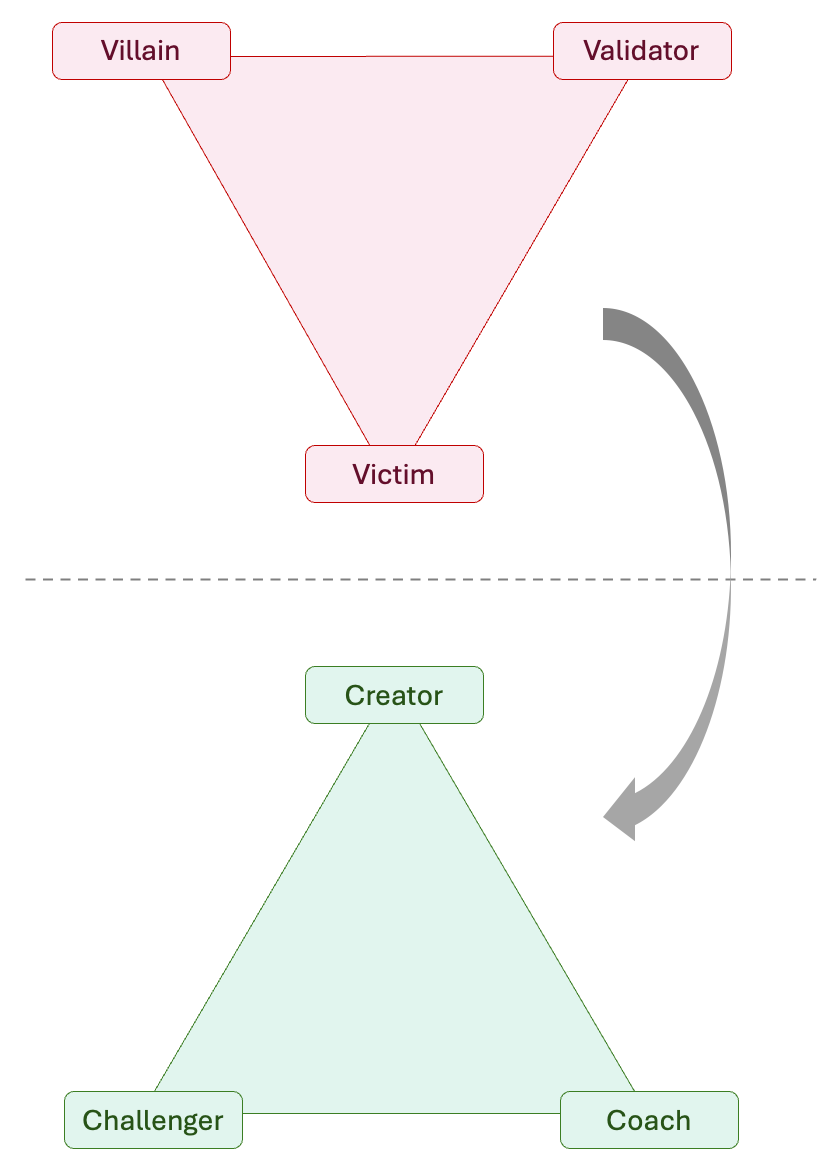
The Victim feels powerless. Life is happening to them. They experience problems as overwhelming, circumstances as beyond their control, and often look to others to fix things as they themselves don’t feel they can. This is the anchor (and at the bottom) of the triangle, the role everything else rests upon.
The Villain (Karpman's Persecutor) is the source of the Victim's suffering, or at least according to the victim. This could be a person (boss, colleague, partner, even your own children), or it can be a thing or a circumstance (traffic, weather, your phone, food, etc). Even when it’s a person, the Villain isn't consciously trying to harm anyone, they're simply reacting from their own place of unmet needs, fear or pressure. But in the victim’s logic, they carry the blame.
The Validator (Karpman's Rescuer) is someone genuinely caring and listening to the victim. But here's the twist, while this feels like the "good" role, it’s really validating the victim’s victimhood and not empowering change. “Poor you”, “there’s nothing you can do”, “I’ll help” are often things heard from the Validator. By solving the problem for the Victim rather than with them, they reinforce the Victim's sense of helplessness. The Validator often acts from their own need to be needed.
What makes the triangle so insidious is its fluidity. In a conversation, you can quickly go from the Victim, then lashing out in frustration and becoming the Villain to the other person, to then stating “it’s not you, it’s...” and taking on the Validator role. This happens subconsciously and constantly. The drama sustains itself.
So, what’s the alternative?
Emerald's answer: The Empowerment Dynamic
David Emerald's insight was elegant: rather than escaping the triangle (which is nigh on impossible), each role in the Drama Triangle has an empowered counterpart. I’m describing this as flipping it.
The Victim becomes the Creator: someone who focuses not on what they can't control, but on what outcome they genuinely want. The shift is from problem-focus to outcome-focus. And notice they’ve moved to the top of the triangle.
The Villain becomes the Challenger: not someone who persecutes, but someone whose presence (however uncomfortable) creates the conditions for growth and learning. Obstacles, difficult feedback, even crises can serve as Challengers when reframed.
The Validator becomes the Coach: someone who believes in the other person's capacity to find their own answers. Rather than rescuing, they ask questions. Rather than solving, they accompany.
The Empowerment Dynamic doesn't eliminate tension or difficulty; it changes our relationship to it.
Useful questions to build awareness and start the transformation
The first move is always awareness; you cannot shift what you cannot see. To start flipping the Drama Triangle, here are some useful questions:
“What role am I playing?” (Creating awareness) When you're in a difficult interaction, pause and ask: am I feeling powerless right now (Victim)? Am I blaming someone or something for the problem (Villain)? Am I rushing in to fix something that isn't mine to fix (Validator)? “Name it to tame it” applies here as well. Recognising and naming it begins to loosen its grip.
“What do I want and what’s the challenge to get it?” (Victim to Creator) Emerald suggests that Creators ask: "What do I want?" Not "what's wrong?" or "whose fault is it?" but genuinely, “what outcome do I care about here?” This deceptively simple question reorients attention from the problem to the possible.
for you to live a fulfilling (not comfortable) life.
Then to further move out of victimhood when someone or something feels like an attack or obstacle, experiment with asking: what might this situation be asking of me? Why is this challenging for me? Not every difficulty is a gift, but many carry information we can only access when we stop fighting them, and that’s often the first step in overcoming them.
“What does this person need from me right now?” (Validator to Coach) If you tend towards the Validator role, try replacing "let me help you with that" with "what do you think you need here?" The difference is subtle but profound, it positions the other person as capable, not dependent.
When engaging with someone playing the Victim, they may first need a hug, they may need to vent, but at some point, they also need to be asked “so what do you want to do about it?”
“What do I need and how do I state that constructively?” (Villain to Challenger). You have needs, rightfully so. The task is to voice them without creating Victims and becoming a Villain in their eyes. This is very dependent on the relationship you have and the present emotional situation (yours, theirs, and the interpersonal). In a nutshell, practice stating your need without over-explaining (and definitely not blaming). If you sense defensiveness, pause (potentially to another day when the emotional environment may be different) and work on explaining it in a different way.
Personally, I find this shift to be the most challenging. I go in with a Challenger mindset, but when I feel misunderstood, I slip into Victim (“why are they being so difficult?”) before lashing out and becoming a Villain (“you’re not listening!”)
Non-Violent Communication3 offers a useful framework if you want to go deeper on this skill - and can be helpful across the board.
The above questions aren't meant to be one-time exercises but rather practices that we should build a habit of asking, one interaction at a time.
In conclusion: Being stuck in the drama triangle is natural, but there’s a better pattern
The Drama Triangle isn't a character flaw, it's a human pattern and most of us cycle through all three roles, sometimes within a single conversation. Karpman gave us useful language, Emerald gave us a way forward.
Recognising the Victim, Villain and Validator in ourselves is not about self-criticism, it's the first act of agency. And from agency, flipping it becomes possible.
This piece was written by me, Jonas Jacobson. I am an executive coach, digital transformation advisor and gender equality advocate among other things.
I’d love to get your feedback, or if you've found this useful, please share further or drop a comment either directly to me (email: jonas at jacobson.coach or Connect), on LinkedIn, or on Substack, there you can also subscribe to future posts from me (you can unsubscribe at any time - no hard feelings, and I will never share or sell your contact information).